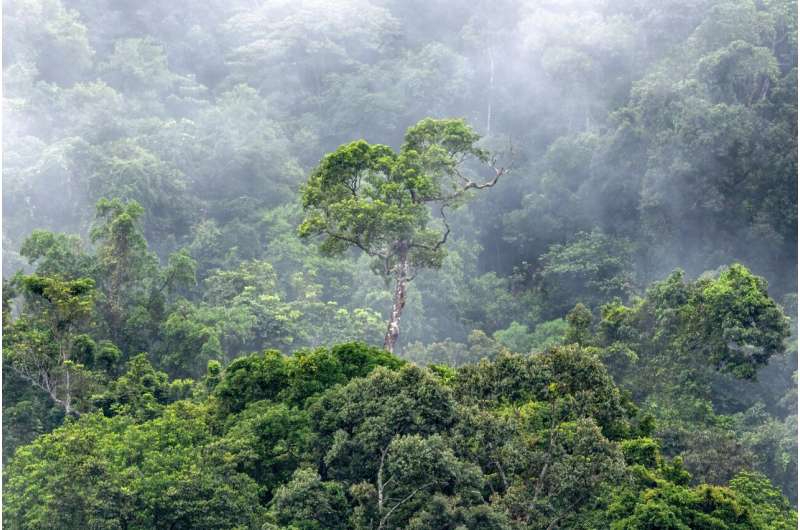
Tropical forests are generating rainfall worth billions of dollars each year, according to new research that puts a price on one of nature’s most overlooked climate services. It comes after researchers at the University of Leeds found that each hectare of tropical forest produces 2.4 million litres of rain annually — enough to fill an Olympic‑sized swimming pool — with the Amazon alone generating rainfall valued at US$20 billion annually for regional agriculture.
Using satellite observations and next‑generation climate models, the researchers resolved long‑standing uncertainty around how much rainfall forests actually produce. They then applied a simplified economic valuation to estimate the rain’s value to society. Their conclusion: the financial value of forest‑driven rainfall dwarfs current incentives to protect or restore tropical forests.
“This is the most comprehensive and robust evidence to date of the value of tropical forests’ rainfall provision,” said lead author Dr Jess Baker of the University of Leeds. “Tropical deforestation is increasing, despite international efforts to halt forest loss. Our work highlights the vital role of tropical forests in producing rain. We estimate that the Amazon alone produces rainfall worth US$20 billion each year. Demonstrating the financial benefits that tropical forests provide will unlock investment and strengthen arguments for forest protection.”
The study shows that many major crops rely on more forest‑generated moisture than the land they occupy. Cotton requires 607 litres of moisture per square metre — equal to the rainfall produced by two square metres of intact forest. Soybeans need 501 litres, which is equivalent to 1.7 square metres of forest.
Decades of forest loss have already imposed steep costs. The researchers estimate that deforestation across roughly 80 million hectares of the Amazon may have reduced rainfall‑generation benefits by nearly US$5 billion annually, with cascading impacts on food production, hydropower, water security and even the carbon‑storage capacity of remaining forests.
Brazil is particularly exposed. With 85 per cent of its agriculture rain‑fed, reduced rainfall and delayed wet seasons have already hit soy and maize yields in heavily deforested regions.
According to Dr Callum Smith, a co-author on the study, the findings highlight a missing piece in global policy debates. “Tropical forests make it rain, supplying water that is essential for agriculture. Recognising that crucial connection could ease tensions between agricultural and conservation interests while building broader support for protecting forests overall.”
For more information: Quantifying tropical forest rainfall generation, Communications Earth & Environment (2026). DOI: 10.1038/s43247-025-03159-3, Journal information: Communications Earth & Environment.
Article created by our partner – Jason Ross – Wood Central
#WoodScanner2.0 #timbersales #timbermarketplace #timberinnovation #timberindustry #morechoices#buyingcompanion